
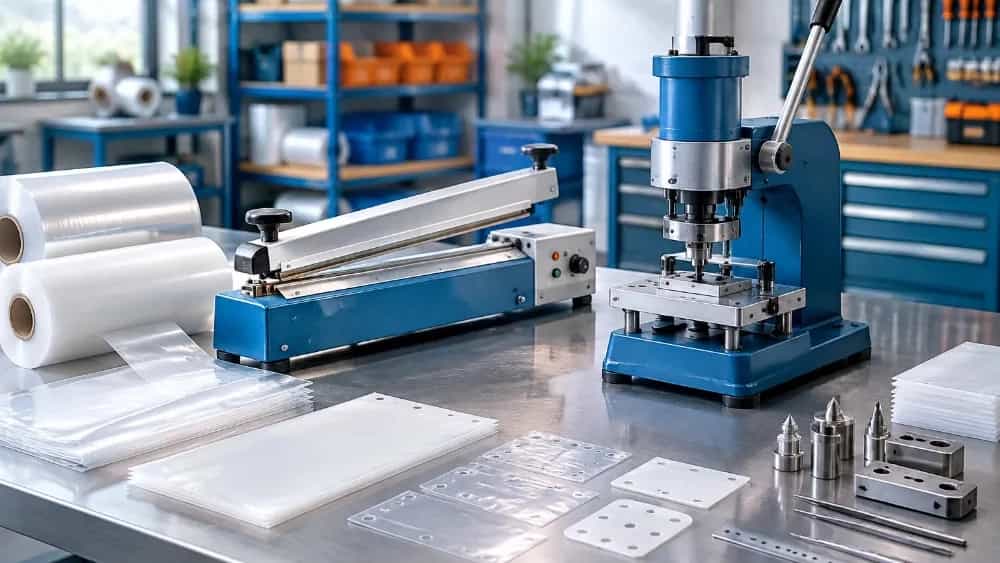
In many manufacturing and packaging workshops, the quality and speed of nylon sewing and punching process has a direct impact on productivity. Using the right equipment makes cutting, stitching and punching operations more accurate and the final products have higher quality and strength. For this reason, choosing nylon sewing and punching machine is one of the important decisions for the owners of small and large workshops.
The machines used for sewing and punching nylon have different models and capabilities, and the choice between them should be made based on the type of nylon, film thickness, production rate, product dimensions, and packaging type. Buying an inappropriate device can increase waste, reduce production speed and create additional costs for the workshop.
Meanwhile, Tekplast Sanat, as a specialized collection in the field of equipment and machinery related to the production and processing of plastic products, can help customers in choosing equipment that suits the needs of the workshop. In the following, we will get to know the most important points of choosing nylon sewing and punching machine.
What is a nylon sewing and punching machine?
Nylon sewing and punching machine is an industrial equipment that is used to create a proper connection on the edges of nylon and also to make holes or punches in its specific parts. This process is used in the production of bags, covers, plastic packaging, industrial bags and similar products.
The sewing machine is responsible for connecting nylon layers and according to the type of machine, it can create thermal or mechanical sewing. The punch section is also used to create regular and precise holes in the product.
Why is it important to choose a nylon sewing and punching machine?
Choosing the right device is not limited to buying an industrial machine. This choice can affect current costs, production rate, product quality and even equipment failure rate.
A suitable nylon sewing and punching machine should be able to work according to the raw materials used in the workshop. If the machine is designed for a certain thickness or type of nylon but is used for different materials, the possibility of poor stitching, tearing or irregular punching increases.
On the other hand, the speed of the machine must be compatible with the actual capacity of the workshop. Buying a machine with a much higher capacity than needed may increase the initial capital, while a machine with a low capacity can cause a bottleneck in the production line.
Checking the type of nylon before buying the device
One of the first things to check when choosing a nylon sewing and punching machine is the type of raw material. Nylons are produced in different thicknesses, dimensions and applications, and each type of material can require different settings.
The thickness of the film, the degree of flexibility, the number of layers and the type of final product are among the factors that must be determined before choosing the device. For example, a device used for light nylons is not necessarily the best choice for thick industrial films.
Therefore, it is better to determine the actual nylon sample used in the workshop and check the performance of the device with the same raw material before purchasing. Consulting with experts in the field of plastic machinery can also prevent wrong choices.
Nylon sewing and punching machine production capacity
Production capacity is one of the most important criteria in choosing a device. Workshop owners must first determine their daily or monthly production and then choose a device that can meet this volume.
For a small workshop, a medium capacity machine may be just fine. But in industrial units that receive large orders, higher speed and continuous work capability become more important.
In choosing a nylon sewing and punching machine, you should not only pay attention to the declared maximum speed. The stability of the machine during long work, the quality of sewing at high speed, the amount of stopping the machine and access to consumable parts are also very important.
Sewing quality in nylon machine
The quality of stitching directly affects the durability of the final product. If the stitching is not uniform or the heat and pressure are not adjusted correctly, the possibility of opening the nylon edges increases.
In a standard nylon sewing and punching machine, the sewing system must be able to create a uniform and reliable connection. Proper temperature control in thermal models, pressure regulation and film passing speed are the most important factors affecting sewing quality.
For workshops where the final product must be resistant to tension or weight, sewing quality becomes doubly important. Therefore, when buying a device, it is better to check its actual performance on the nylon used.
The importance of the punch system in the machine
Nylon punching is used in many products to create handles, vents, hangers or special applications. The shape, size and location of the punch must be accurate so that the final product has a professional appearance and proper performance.
Nylon sewing and punching machine should provide the possibility to create a regular punch that fits the dimensions of the product. If the punches are out of the designated place or the distance between them is not the same, the final product will not be of good quality.
For workshops that produce various products, the ability to adjust the device is of particular importance. The flexibility of the device makes it possible to produce different products with a set of equipment.
Paying attention to the ability to adjust the device
One of the important features of industrial equipment is the possibility of adjusting them for different production conditions. Adjusting the speed, temperature, pressure, punch distance and product dimensions can allow the workshop to produce more diverse products.
When buying a nylon sewing and punching machine, it is better to check the operator's access to the device's settings and the ease of working with the control system. A device that has complex and time-consuming settings may reduce productivity in workshops with constant product changes.
Energy consumption of nylon sewing and punching machine
Energy cost is one of the continuous costs in production units. For this reason, when choosing a device, you should not only consider the initial price. The power consumption and efficiency of the device should also be checked.
A properly designed device can result in lower operating costs over time. Of course, energy consumption should be checked along with production speed, capacity and product quality; Because a low-power but slow device is not necessarily a more economical choice.
In collections like Tek Plast Sanat, checking the real needs of the customer before choosing equipment can help to make a more accurate decision to buy the right machinery.
The strength and quality of the device
Industrial machines must have adequate resistance in continuous working conditions. Chassis, mechanical parts, heating system, engine and control components are parts whose quality affects the life of the device.
At the time of buying nylon sewing and punching machine, attention should be paid to the quality of construction, the brand of parts, the possibility of service and provision of spare parts. A device that remains out of the production line for a long time in case of failure can impose significant costs on the workshop.
After-sales service and supply of parts
One of the important points that is sometimes overlooked when buying machinery is after-sales service. Any industrial device may need service, adjustment or replacement of consumable parts during its lifetime.
Therefore, before purchasing a nylon sewing and punching machine, one should get enough information about access to spare parts, operator training, repairs and technical support.
Proper support reduces production line downtime in the event of a problem. This issue is very important for workshops that have continuous orders and specific schedules.
What are the features of a suitable device for a small workshop?
Small workshops usually face the limitation of capital, working space and manpower. Therefore, the device used in such an environment should not occupy a lot of space in addition to proper performance, and its use should be simple for the operator.
For these workshops, the selection of nylon sewing and punching machine should be done based on the actual volume of production. Buying a very large and high-capacity device at the beginning of the activity may involve capital without sufficient use.
It is better to determine the current needs and growth prospects of the workshop first, and then choose a device that can respond to the increase in production in the future.
Choosing a device for large production workshops
In large workshops and industrial units, the speed of the machine is not the only issue. The coordination of the sewing and punching machine with other parts of the production line, the degree of automation, the ability to work continuously and the possibility of quality control become more important.
In this situation, Nylon sewing and punching machine should be coordinated with the capacity of other line equipment. If one of the production steps has a much lower speed, the capacity of the entire line will decrease.
For this reason, experts in the field of machinery can suggest more suitable equipment by examining the production process. Tek Plast Sanat can also be taken into consideration to choose equipment according to the type of activity and the expected capacity of the workshop.
Proper maintenance of nylon sewing and punching machine
Regular maintenance can increase the useful life of the equipment. Cleaning different parts of the device, checking moving parts, controlling the heating system and checking connections are among the actions that should be done according to the manufacturer's instructions.
The operator should also have adequate training on how to work with nylon sewing and punching machine. Improper use can cause rapid depreciation of parts and decrease in product quality.
Periodical services should also be taken seriously. Detecting a small fault in the early stages is usually much less expensive than repairing a widespread failure.
Why check Tekplast Sanhat for equipment selection?
Tek Plast Sanat, focusing on the equipment and machinery needed by the plastic industry, can be one of the options to consider for workshops that are looking to choose the right equipment. In such a purchase, it is very important to know the customer's needs and match the technical specifications of the device with the production process.
Choosing nylon sewing and punching machine should be done according to the type of product, production volume, nylon thickness, required speed and workshop environment conditions. Getting advice before buying can avoid the costs caused by wrong choice.
If your goal is to increase production speed, reduce waste, and achieve consistent quality in nylon products, checking machine specifications and comparing available options can be a good start. Tekplast Sanat can be the attention of producers and activists of the plastic industry in the way of choosing equipment that suits the needs of the workshop.
Summary
Choosing a nylon sewing and punching machine is one of the important decisions for any plastic products manufacturing workshop. Nylon type, material thickness, production speed, sewing quality, punch accuracy, energy consumption, adjustability, manufacturing quality and technical services are the most important factors that should be checked before buying.
A principled choice can increase productivity, reduce waste and better control production costs. On the other hand, choosing a device based solely on price may create more costs for repair, maintenance and production line shutdown in the future.
For a more accurate selection, it is better to determine the actual needs of the workshop and match the technical specifications of the devices with the product type and production volume. Tekplast Sanat, as an active group in the field of plastic industry equipment, can be a suitable option for checking and receiving specialized information about machinery related to nylon production and processing.